Dr. Klaus Seppeler Stiftungspreis für Herrn Dr. Bahram Vaghefinazari
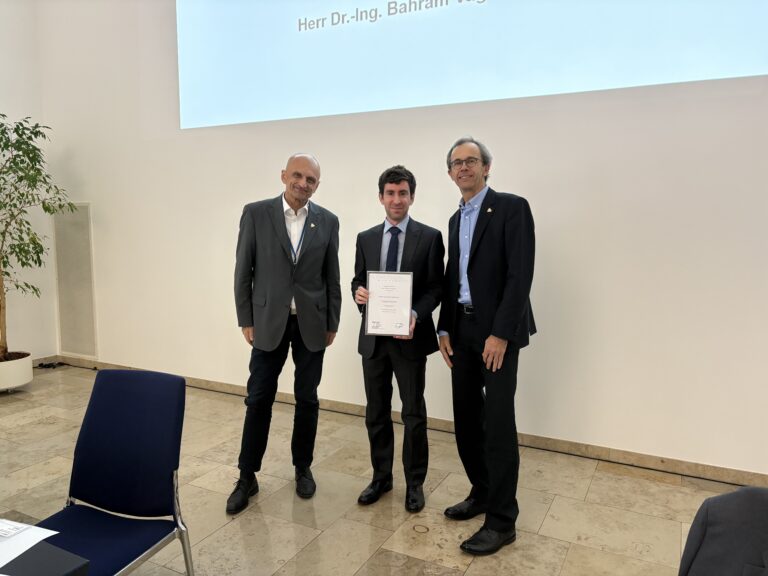
Dr. B. Vaghefinazari mit Prof. Dr. Wolfram Fürbeth und Prof. Dr. Ralf Feser bei der Preisverleihung.
Zum 21. Mal wurde auf der Mitgliederversammlung am 4. November 2025 der Stiftungspreis verliehen. Herr Dr. Bahram Vaghefinazari wurde für seine Doktorarbeit „Corrosion inhibitors for bare and PEO-coated Mg alloys“ geehrt.
The increasing demand for sustainable and energy-efficient materials in industries such as automotive, aerospace, and biomedical engineering has brought magnesium (Mg) alloys to the forefront due to their exceptional strength-to-weight ratio, low density, and biocompatibility. However, the application of Mg alloys is significantly hindered by their high susceptibility to corrosion, particularly in aqueous environments. Plasma Electrolytic Oxidation (PEO) coatings have been proposed as a promising solution, offering a protective barrier and the potential for „active protection“ through the incorporation of corrosion inhibitors within their porous structure. Despite the potential of this approach, the field remains underexplored, with limited research on effective corrosion inhibitors for PEO-coated Mg alloys.
This thesis addresses this gap by systematically investigating a range of corrosion inhibitors to enhance the corrosion resistance of PEO-coated Mg alloys. An initial evaluation of more than twenty potential inhibitors revealed that their effectiveness on bare Mg alloys does not necessarily translate to improved corrosion resistance in PEO-coated systems. For example, while the sodium salt of 2,5-pyridinedicarboxylate (2,5PDC-Na) was effective on bare Mg, it was found to accelerate the degradation of PEO coatings, highlighting the complexity of inhibitor interactions within PEO-coated magnesium systems. Consequently, an in-depth investigation was conducted to understand these unexpected adverse effects, ultimately providing insights into the selection of effective inhibitors for PEO-coated Mg alloys.
Among the tested inhibitors, sodium salts of 8-hydroxyquinoline (8HQ) and decylphosphonic acid (DP) were found to significantly improve the corrosion resistance of PEO-coated AZ21 Mg alloy. DP, in particular, demonstrated superior inhibition performance by delaying the failure of the PEO coating by over 50 days, compared to the 4-day failure time of the reference PEO coating without an inhibitor. The formation of insoluble compounds between these inhibitors and Mg²⁺ ions contributed to the enhanced protection through several mechanisms. Given DP’s outstanding inhibition performance, a protective PEO system was further developed by loading the PEO layer with a high concentration of DP, which significantly reduced corrosion creep from defect in a salt spray test.
Based on the findings from the in-depth investigation of the inhibition effects of these three chemicals (2,5PDC-Na, 8HQ, and DP), a set of criteria was established for selecting effective corrosion inhibitors to be incorporated into PEO coatings on magnesium. A key parameter in these criteria is the formation of highly insoluble compounds resulting from the interaction between the inhibitor and Mg²⁺ ions. These criteria were evaluated for the initially screened compounds to assess their validity across different types of inhibitors.
The findings of this thesis contribute to a deeper understanding of the interactions between corrosion inhibitors and PEO-coated Mg alloys, providing a framework for the selection and application of inhibitors for PEO-coated magnesium. The insights gained from this research are expected to inform future studies and industrial practices, ultimately supporting the development of more durable and corrosion-resistant Mg alloy-based components for various critical applications.